Measurement System
The qldgrid.observer project independently measures power-system frequency from the electricity supply in Queensland. The live frequency measurements displayed on this site are produced by our own measurement system and are not sourced from the Australian Energy Market Operator (AEMO).
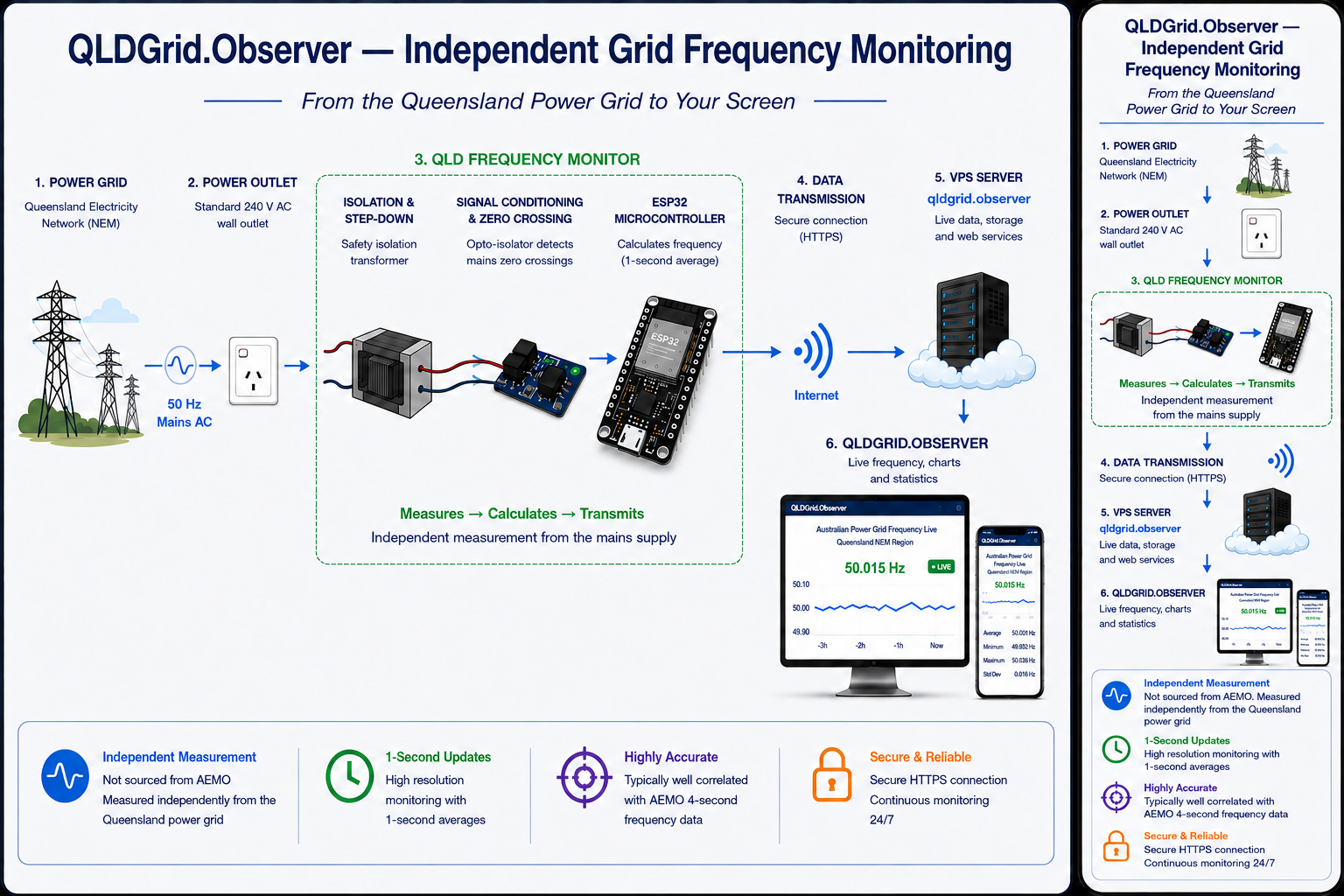
Frequency is determined from mains zero crossings using an isolated measurement interface and an ESP32 microcontroller. Measurements are averaged over one-second intervals and transmitted to qldgrid.observer for storage, display and analysis. The measurements are typically well correlated with AEMO's published four-second frequency deviation data.
How it works
The Queensland mains supply is connected to the measurement system through a safety-isolating step-down transformer. An opto-isolated zero-crossing detector provides the ESP32 microcontroller with timing information from which grid frequency is calculated.
The ESP32 processes the measurements locally to produce one-second frequency averages. These measurements are timestamped and securely transmitted via the internet to the qldgrid.observer server, where they are stored for live display and subsequent analysis.
Because the measurement is made directly from the Queensland electricity supply, qldgrid.observer provides an independent observation of NEM system frequency, rather than reproducing an existing frequency data feed.
Comparison with AEMO data
The Australian Energy Market Operator publishes four-second frequency deviation data for the NEM. This provides a useful independent reference against which qldgrid.observer measurements can be compared.
Measurements from qldgrid.observer have shown good agreement with the AEMO data. Further automated comparison and correlation analysis is planned to provide ongoing validation of the independent measurement system.